eukalyptusdesign · AI Campaign Months 2026

Local AI on equal terms.
Sovereign. Practical.

Workshops, prototypes and local AI hardware for teams that want to understand AI — instead of just renting it. In depth since 2023. Productive in the market since the end of 2024.

100 % positive client feedback GDPR / AI Act compliant Hands-on, on site
Since 2009 + 2025
Cologne + Weimar
Design · Web · AI
Owner-managed
Apple Silicon
NVIDIA DGX Spark

In 2026, AI is no longer a question — the question is who you entrust your data to. Cloud AI is convenient. Local AI is sovereign. We build the second option with you. And yes: in many cases it will be cheaper.

🔒
Data stays
in-house.

GDPR and AI Act compliant not through legal construction, but through genuine on-premise inference. No data processing agreements, no CLOUD Act risk.

👻
We are done
when you are fit.

We come in, work shoulder to shoulder with your team and leave again. The goal is your independence — no lock-in.

🍎
Apple or NVIDIA
instead of rented servers.

Up to 1,200 GB/s memory bandwidth (Mac Studio M5 Ultra), manageable power draw, no data-centre noise. In many cases this makes local inference cheaper than cloud alternatives.

Who we are

Design DNA.
Tech depth.
Since 2009.

Founded in Cologne in 2009, also in Weimar since October 2025: Jessica Rudzki and Stephan Schug bring together what is rare in the AI market — decades of communication skills from design and web, and real technical depth in Python, TypeScript, local LLMs, RAG and fine-tuning.

With us, AI is not unleashed on organisations by data scientists. It is introduced by people who have spent decades designing, explaining and integrating software into real companies. That is the difference.

Generative AI
since 2023
Depth without marketing haste. Productive and revenue-generating in the market since the end of 2024.
Specialist areas
local LLMs · RAG · fine-tuning · WordPress · WooCommerce · Moodle · LearnDash · Python · TypeScript
Rooted in society
Adult-education courses, federal volunteer service, open AI cafés in Weimar and Brühl near Cologne, school-holiday camps in Erfurt, volunteer work — building AI skills beyond the tech bubble.
Campaign Months 2026

Three offers.
One promise.

Offer 01
AI workshops &
prototypes

From use case to working prototype — shoulder to shoulder with your developers.

  • Use-case identification & ideation with design-thinking tools
  • Hands-on implementation: Python / TypeScript / local LLMs / RAG pipelines
  • Iterative development in your team’s repository, transparently documented
  • Proof of concept with clear success criteria — no demo theatre
Request a PoC outline →
Offer 02
Specialised
AI training

Three tracks. Two hours to three days. Tailored to your organisation — not to our slide library.

  • Users track: prompting, tools, day-to-day work
  • Decision-makers track: use-case assessment, risk, governance
  • Developers track: architecture, evals, RAG, local models
  • Fulfilment of the AI literacy obligation (Art. 4 EU AI Act) can be documented
  • Always use-case-specific — no standard presentation
Request a training format →
Offer 03
Local AI hardware &
development

Your own Apple or NVIDIA hardware as a serious alternative to cloud GPUs.

  • Consulting, procurement, setup and onboarding from a single source
  • Unified memory — large models run entirely in memory
  • Power draw 50–200 W instead of 350–1,000 W for multi-GPU workstations
  • MLX, llama.cpp, Ollama, vLLM-MLX, oMLX, LM Studio — production-ready toolchain
  • Hybrid setups (DGX Spark + Apple Silicon) on request

Note on availability: Apple presented the new generation on 25 August 2026, with deliveries from 22 September 2026. Our AI boxes are based on the Mac mini M6 with 32 GB of memory (for 48 or 64 GB the M5 Pro variant that Apple continues to sell alongside is a prerequisite) or on the Mac Studio (18-core CPU / 40-core GPU) with 64 GB of memory (configurations with 256 GB of memory are available; a 512 GB configuration has been announced but could not be ordered at market launch and has not yet been priced by Apple). Delivery times are currently very volatile. Until delivery, or in case of shortages, we alternatively procure available NVIDIA DGX Spark or Apple refurbished setups. [As of: 19 October 2026]

Technical arguments →
For tech leads & CTOs

Practical.
No soft focus.

You know NVIDIA. CUDA has been the default for 15 years. We respect that — and still make the counter-offer. Not out of Apple conviction, but out of memory-bandwidth arithmetic.
“Your developers should understand and master AI — not need us. We come in, join in, and leave again.”
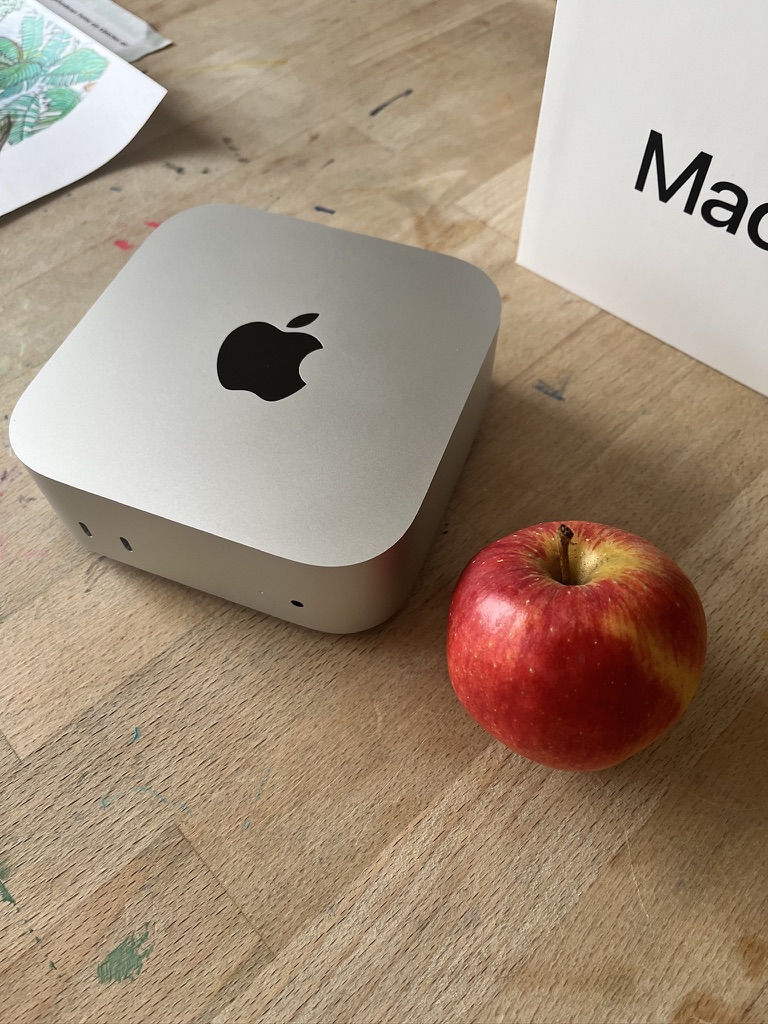
Mac mini M4 Pro next to a real apple — our first PoC hardware
Mac mini M4 Pro — our first PoC hardware. Chosen deliberately, and it convinced us straight away. From 273 GB/s memory bandwidth, 30–65 W power draw — local, quiet, production-ready.
Memory bandwidth decides — not FLOPs
LLM inference is memory-bound. Tokens/s scales with bandwidth, not with theoretical compute.
DGX Spark
273 GB/s
LPDDR5x
Mac Studio M5 Ultra
1,200 GB/s
Unified memory
With large models, Apple Silicon is often faster than DGX Spark — and always faster than CPU/disk-offload workarounds.
Memory capacity: who really runs 70B models
Qwen3.8-27B (Q4, MLX, ~18 GB) and Qwen3.6-35B-A3B (Q4, MLX, ~24 GB) are our everyday workhorses — the latter as an MoE with only 3 B active parameters. Both run comfortably on Mac mini / Mac Studio class machines, via MLX (Apple-native) or llama.cpp even on small hardware. On Apple Silicon, MLX delivers noticeably higher token rates than llama.cpp — the differences between backend and hardware class are sometimes considerable. Llama 3.1 70B (Q4) needs ~40–50 GB: DGX Spark can do that (128 GB), Mac Studio M5 Ultra with headroom (256 GB, from EUR 10,999). Extreme cases such as DeepSeek R1 671B (Q4, ~404 GB), on the other hand, exceed the Apple desktop hardware that could be ordered at market launch (22 September 2026; max. 256 GB; a 512 GB configuration of the Mac Studio M5 Ultra has been announced, but could not be ordered at market launch and has not yet been priced by Apple) and do not run standalone on DGX Spark anyway — here cloud or a multi-node setup remains the realistic option.

Important for the Mac mini: the new M6 chip is capped at 32 GB — for 48 or 64 GB (e.g. smaller models up to ~30B) the M5 Pro variant that Apple continues to sell alongside (from EUR 1,999) is mandatory; the M6 is technically not an option for this.

Our position: for PoCs and prototyping up to 70B, Apple Silicon is the more economical choice. Training and fine-tuning >70B remains CUDA territory. Honestly.
TCO: when does local hardware pay for itself?
Mac Studio M5 Ultra, 256 GB: EUR 10,999–12,429 purchase price (official Apple price, as of 1 September 2026 — depending on GPU core count, 1 TB SSD), ~EUR 60–120 electricity per year depending on usage intensity.
DGX Spark: ~EUR 6,000–6,700 gross (Germany, 128 GB; according to dealer lists as of September 2026: cheapest OEM variant approx. EUR 6,000, Founders Edition approx. EUR 6,680 — prices rose in 2026 due to the memory shortage; a 64 GB variant from approx. EUR 3,750 gross has been announced for October 2026), ~EUR 90–150 electricity per year (less efficient than Apple Silicon) — but bandwidth is limited.
Cloud API (hosted Llama 70B): EUR 200–800 per month depending on volume, plus data leakage.

With more than ~EUR 1,000 per month in cloud API costs, the Mac Studio can pay for itself within 11–13 months; the cheaper DGX Spark already at significantly lower monthly cloud costs in a similar period — plus the compliance advantage that cannot be monetised.
Software maturity 2026: MLX, llama.cpp, vLLM
MLX (Apple’s native ML framework) has been production-ready since 2025/26, with partial CUDA support as a bridge. llama.cpp, Ollama, LM Studio and vLLM-MLX offer a broad tooling base. Hugging Face models are largely available in GGUF/MLX formats.
Hybrid setups: DGX Spark + Mac Studio
EXO Labs shows: DGX Spark prefill + Mac Studio decode can, depending on the workload, be 2.8× faster than the Mac Studio alone (vendor benchmark with M3 Ultra and Llama 3.1 8B at an 8,192-token prompt; results depend strongly on model and setup). We do not sell a tool — we recommend the right topology for your use case. Even if that means: DGX Spark.
For management & C-level

Ready to act.
Legally sound. 2026.

We bring your team into a capable, legally sound AI mode — tailored to your use cases, not off the shelf.

⚖️

AI Act & GDPR

Art. 4 EU AI Act requires measures for AI literacy among staff (since 2 February 2025; since the AI Omnibus of 27 July 2026 without a guarantee of a specific level of competence). High-risk obligations apply later (Annex III from 2 December 2027). Fines can threaten a company’s existence.

We deliver documentable training under Art. 4
🫥

Stop shadow IT

Your employees have long been using cloud AI — just not securely. Local AI solutions eliminate the GDPR risk structurally, not through bans.

Data does not leave the building — neither physically nor logically
📈

Competitiveness

41 % of German companies actively use AI (Bitkom 2026) — 59 % do not yet. We shape the start with you — local and sovereign.

Funding note: BAFA up to 80 % (eastern German states), application by 31 December 2026 · QCG
“Three days, twelve employees, one use case. After that your team is ready to act — documented, verifiable, AI-Act compliant.”
Strategy call (45 min) Request an AI competence check
How we work

Four steps.
One goal.

01
Understand 🔎

Use-case workshop, as-is analysis, hardware sizing. We listen before we build.

02
Build 🏗

PoC / prototype, local or hybrid, shoulder to shoulder with your development team. No demo theatre.

03
Enable 💪

Training for users, decision-makers, developers — documented, use-case-specific, AI-Act compliant.

04
Let go 🚀

We leave. Your team can. That was always the plan.

— Until you are fit.

Why eukalyptusdesign

Facts, not
promises.

Client feedback
100 %
Not “mostly positive”. In fact 100 % positive feedback across all completed projects and training sessions.
AI experience
since 2023
Depth in generative AI — not only since the ChatGPT hype. Productive and revenue-generating in the market since the end of 2024.
Owner-managed
since 2009
No investor logic, no scaling promises. Jessica Rudzki and Stephan Schug are personally involved in every project.
Rooted in society
adult education + volunteer service + open AI cafés
AI training for working people, federal volunteers and volunteers in civic roles — plus open AI cafés in Weimar and Brühl near Cologne and school-holiday camps in Erfurt. Building skills beyond the tech bubble.
Frequently asked questions

FAQ

Do we need our own hardware?
No — not necessarily. We can start with your existing infrastructure (cloud hybrid, existing workstations) and only recommend hardware when it makes economic and technical sense. If you want to buy your own hardware, we advise, procure and implement completely.
How does Apple Silicon compare with NVIDIA DGX Spark?
For local inference with models up to 70B, Apple Silicon (Mac Studio M5 Ultra, 1,200 GB/s) is often faster than DGX Spark (273 GB/s) — because LLM inference is memory-bound. For training >70B and CUDA migration paths into NVIDIA data centres, DGX Spark makes more sense. We will tell you honestly which setup fits your use case. More details in the tech-lead section of this page.
Does local AI meet the obligation under Art. 4 EU AI Act?
Since 2 February 2025, Art. 4 AI Act has required companies that use AI to take measures to promote the AI literacy of their staff. Since the AI Omnibus (Regulation (EU) 2026/1744, in force since 27 July 2026), companies do not have to guarantee a specific level of competence; documented training remains an obvious way to demonstrate the measures. Our training is use-case-specific, documentable and designed to fulfil this obligation — regardless of whether you use cloud or local AI. We are happy to advise you directly on the requirement.
What does a typical PoC cost?
That depends strongly on the use case, the desired model size and the maturity of your existing infrastructure. A first tech sparring session (30 min, free of charge) gives us the basis for a concrete offer. Typical PoC projects run for a few weeks and are calculated transparently based on effort.
Do you work remotely or on site?
Both — depending on the project phase. For workshops, hardware onboarding and shoulder-to-shoulder implementation we prefer to be on site. Concept, coding and support can run hybrid. We are easy to reach from Cologne and Weimar — across Germany.
Can the training be funded through BAFA or QCG?
Possibly. BAFA consulting funding (applications possible until 31 December 2026; continuation afterwards open) covers up to 80 % in the eastern German states and 50 % in the western ones — particularly relevant for locations around Weimar. QCG (Qualifizierungschancengesetz, a German training-funding law) may apply to employee training. We are happy to check eligibility with you.
For tech leads & development teams

Book tech
sparring

30 minutes, free of charge. Architecture, hardware sizing, stack questions — no sales pressure. An honest assessment of whether and how we can help.

Arrange tech sparring → Request an architecture sketch
For management & C-level

Arrange a
strategy call

45 minutes. Use cases, compliance status, funding options, realistic entry path. Tailored to your company.

Book a strategy call → Request an AI competence check